
Curtain Pleat Styles Compared: S-Fold, Pinch Pleat, Double and French
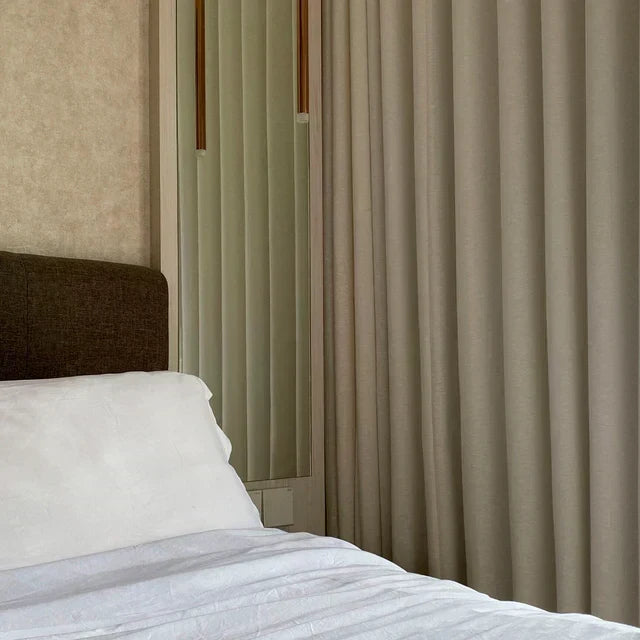
S-fold curtains cost the most of any heading style, eyelet costs the least, and the pleated styles sit between them. The reason is fabric. An S-fold heading is cut at up to 2.5 times the window width and runs on its own track, while an eyelet heading uses under 2 times and hangs on a rod.
In this guide, we compare every curtain pleat style on cost, fullness and finish, with the naming confusion settled first.
Book a Free In-Home Consultation
We bring samples of every heading style to your windows.
Book a consultationRated 4.8 out of 5 across 126 Google reviews
What Is the Difference Between the Curtain Heading Styles?
S-fold, pinch pleat, double pleat, French pleat and eyelet are the five curtain heading styles specified in most Singapore homes. S-fold is the most expensive because it uses the most fabric and needs a dedicated track. Eyelet is the cheapest. Pleated styles sit between the two on cost and formality.
S-Fold, Wave Pleat and Ripplefold Are the Same Thing
S-fold, wave pleat and ripplefold describe the same heading style. Three names, one construction: a continuous wave held by carriers that run inside a dedicated track. If one supplier quotes a ripple fold curtain and another quotes S-fold, you are comparing the same product.
Pinch pleat is the family name rather than a single style. Locally, it is almost always specified as a double pleat, meaning two folds gathered into each pleat. French pleat is the triple pleat, three folds per pleat, and it is the most structured of the group.
Korean pleat and Singapore pleat are workroom trade names rather than distinct constructions, and what they mean shifts between suppliers. Ask which pleat is actually being sewn before you compare two quotations.
Cost Comparison at a Glance
Fullness ratio is the whole explanation for the price difference. A heading cut at 2.5 times the window width uses a third more fabric than one cut at 1.9 times, and fabric is the largest line in any curtain quotation. Track type accounts for most of the rest.
| Heading Style | Fullness Ratio | Fabric Cost Impact | Track or Rod | Per HDB Window | Per Living Room Window |
|---|---|---|---|---|---|
| Eyelet | 1.8x to 2x | Baseline | Rod, or track with rings | S$200 to S$400 | S$520 to S$1,000 |
| Double / pinch pleat | 2x to 2.2x | ~10% more fabric | Standard track or rod | S$240 to S$500 | S$620 to S$1,250 |
| S-fold / ripplefold | 2.2x to 2.5x | ~25% more fabric | Dedicated S-fold track | S$280 to S$580 | S$720 to S$1,450 |
| French / triple pleat | 2.4x to 2.6x | ~30% more fabric | Standard track or rod | S$320 to S$650 | S$820 to S$1,650 |
Measured on fabric alone, a double pleat uses roughly 10% more than eyelet, S-fold roughly 25% more, and French pleat roughly 30% more, for the same window. The finished price gap widens further on S-fold, because the dedicated track costs more than a standard one.
Full per-window figures sit in our curtain price guide for Singapore.
Get an Exact Price for Your Window and Preferred Heading Style
Free measurement, no obligation.
Arrange a measurementPinch pleat versus S-fold is the comparison most homeowners arrive at, and the two differ on more than appearance. The table lines up every attribute that changes between them, including two that quotations rarely mention: where the fabric sits relative to the track, and how much wall the curtain occupies when drawn open.
| Attribute | Pinch Pleat | S-Fold |
|---|---|---|
| Style | Evenly spaced folds or pleats across the top, classic and tailored | Continuous, flowing folds, modern and minimalist, gentle S shape |
| Fullness | Requires less fabric, less full appearance | Fuller in appearance, requires more fabric |
| Light coverage | Can cover the tracks, limiting light seepage from the top | Hangs beneath the curtain tracks, allowing light to come through |
| Without a pelmet | Top light still blocked | Light seepage above the fabric line |
| Track | Standard track or rod | Requires a specific track system |
| Stack-back depth | Shallower | Around a fifth of track length |
| Budget | More budget-friendly | More expensive |
| Control options | Manual or motorised | Manual or motorised |
| Best rooms | Bedrooms, study rooms, areas requiring significant light coverage | Living rooms |
S-Fold and Ripplefold Curtains
S-fold curtains feature continuous, flowing folds, creating a modern and minimalist look with a gentle S shape. They have a more uniform and streamlined appearance compared to pinch pleat curtains, and they are fuller, requiring more fabric.
The wave carries best in lighter cloth. A day curtain in a sheer or a light linen moves through the fold the way the style intends, which is why we specify S-fold most often for day layers and wide living room spans.
Stack-back is the trade-off. Because every fold stays open, an S-fold curtain occupies more wall when drawn back than a pleated one, typically around a fifth of the track length.
Pinch Pleat, Double Pleat and French Pleat
Pinch pleat curtains feature evenly spaced folds or pleats across the top, creating a classic and tailored appearance. They require less fabric than S-fold curtains and have a less full appearance, which is what makes them more budget-friendly.
The difference between the pleated styles is the number of folds gathered into each pleat. A double pleat curtain takes two, a French pleat takes three. More folds per pleat means more fabric consumed and a deeper, more sculptural head, which is why French pleat suits heavier cloth. Lightweight fabric cannot hold a triple pleat open and the head collapses. A night curtain in a heavy dim-out is where French pleat earns its cost.
Choosing between S-fold and pleated curtains is partly a question of register. Pleated headings read tailored and traditional. S-fold reads architectural.
Eyelet and Other Budget Headings
An eyelet curtain is the cheapest heading you can specify. Metal rings punched through the fabric slide directly over a rod, so there is no pleat tape, hooks or carrier system to pay for. Fullness sits at 1.8 to 2 times the window width, the lowest of any style.
What you give up is control at the top. The rod stays visible, the fold is wider and less regular than a sewn pleat, and light passes above the fabric line unless a pelmet covers it. Eyelet also resists motorisation, since the rings must clear the rod by hand.
Pleat Spacing, Fullness and How Many Pleats You Need
Pleats sit 10 to 15cm apart on a standard heading, which works out at 6 to 10 pleats across a standard window. Heavier fabric needs the wider end of that spacing, because a dense cloth gathered too tightly cannot fall cleanly between pleats.
Fullness ratio is the figure to ask for:
- Eyelet runs 1.8 to 2 times the window width
- Double pleat 2 to 2.2
- S-fold 2.2 to 2.5
- French pleat 2.4 to 2.6
Any quotation below 2 times on a pleated style will hang flat.
Ready-made panels cannot account for a specific window's proportions. They arrive at a fixed width and pleat count, so the spacing lands wherever the manufacturer puts it, not where your window needs it.
Do S-Fold Curtains Need a Special Track?
Yes. S-fold curtains require a specific track system designed for smooth and effortless operation, and this is the one heading style that cannot be retrofitted to whatever is already installed. The fabric hangs from carriers spaced along the track at fixed intervals, and those carriers are what hold the wave.
An S-fold curtain track differs from a normal track in cost and construction. Budget a premium over a standard track, and more for a ceiling-recessed installation, which needs specifying before your renovation carpentry closes up. Our curtain tracks cover both, and because the carriers already move under load, S-fold is the easiest heading to power, which is where our motorised curtains come in.
An existing standard track cannot be reused for S-fold. Pleated and eyelet headings are more forgiving: a pinch pleat or French pleat will hang from most standard tracks or a decorative rod with rings.
Which Should You Choose?
Choose on aesthetic preference first: a classic, traditional style points to pleated, a modern and minimalist one points to S-fold. Then test that choice against the window itself, using the factors below. Two of them are easy to miss until the curtains are up.
| Factor | Points to Pleated | Points to S-Fold |
|---|---|---|
| Aesthetic preference | Classic, tailored, traditional | Modern, minimalist |
| Window width | Narrow to standard windows | Wide spans |
| Room function | Bedrooms, study rooms | Living rooms |
| Fabric weight | Heavier cloth, especially French pleat | Lighter cloth and sheers |
| Maintenance | Pleats hold shape through cleaning | Wave needs resetting after washing |
| Budget | Lower | Higher |
| Ceiling height | Standard drops | Full-height drops, where the wave reads best |
| Motorisation planned | Works either way | Pairs best with a motorised track |
Ceiling height and motorisation are the two worth raising early. S-fold suits motorised and smart curtain systems better than any pleated heading, because the carriers move under load without snagging.
Still Deciding?
See every heading style in person at our showroom on River Valley Road.
Book a consultationFrequently Asked Questions About S-Fold Curtains vs Pleated Curtains
What is an S-fold curtain?
An S-fold curtain is a heading style where the fabric falls in a continuous wave rather than gathered pleats, held by carriers running in a dedicated track. It is also sold as wave pleat and ripplefold. Aratamete specifies it most often for day curtains and wide living room spans.
Is S-fold more expensive than pleated?
Yes. S-fold costs more than any pleated heading because it uses roughly 25% more fabric than eyelet and 15% more than a double pleat, and it requires a dedicated track that a standard pleated curtain does not. Expect the gap to widen on wide windows.
Is ripplefold the same as S-fold?
Ripplefold and S-fold are the same heading style under different trade names, along with wave pleat. All three describe fabric held in a continuous wave by track carriers. Any difference between two quotations using these terms is a difference in fabric or track, not in the heading.
Which uses more fabric?
French pleat uses the most fabric at 2.4 to 2.6 times the window width, with S-fold close behind at 2.2 to 2.5. Double pleat runs 2 to 2.2 times, and eyelet uses the least at 1.8 to 2 times. Fullness ratio drives the cost difference.
How far apart should curtain pleats be?
Curtain pleats sit 10 to 15cm apart, producing 6 to 10 pleats across a standard window. Heavier fabrics take the wider spacing so the cloth falls cleanly between pleats. Spacing tighter than 10cm on heavy fabric crowds the head and flattens the fold.
Which heading style is best for an HDB flat?
Double pleat suits most HDB flats. It holds light out at the track, works with standard tracks already installed in many units, and costs less than S-fold. Specify S-fold in living rooms with wide spans and wall to stack against.
Can I change my heading style later?
Yes, between pleated styles and eyelet, since existing curtains can be remade with a new heading using the same fabric. Changing to S-fold usually means a new track as well, because standard tracks cannot carry the wave. Fabric quantity also limits which direction you can move.
See Every Pleat Style Side by Side
Heading style is a decision that photographs poorly and reads clearly in person. Our showroom on River Valley Road hangs every style at full drop, in the fabrics they are usually specified in.
Looking to buy curtains in Singapore? Book a free measurement and we will bring the samples to your windows. Or browse our S-fold and ripple curtains to start with the style most Singapore living rooms end up choosing.
Rated 4.8 out of 5 across 126 Google reviews · Prices verified August 2026