
Roman vs Honeycomb Blinds (Cellular Shades): A Practical Choice for the Refined Home
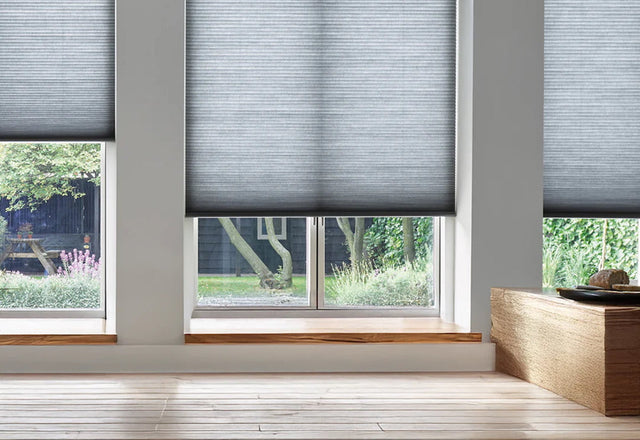
Roman blinds and honeycomb blinds occupy similar spaces in a home. Both belong in bedrooms, studies, and rooms where full-length curtains would crowd the layout or simply miss the practical point. The similarity ends at installation.
One is a fabric decision. The other is a performance decision. Both, done well, carry the same durability standard we hold across every window treatment we produce, from a condominium study to a guestroom at the Mandarin Oriental.
The Roman Blind: Timeless Texture and Longevity
The Roman blind is a fabric window treatment that folds into horizontal pleats when raised. At full drop, it sits flat against the window. The quality of the fabric does most of the visible work.
In a study or bedroom, this tends to matter. Roman blinds carry more warmth than slat or cellular alternatives. The fold adds visual depth that a plain panel does not, and in rooms where the furniture and wall finishes are already doing the heavier design work, a Roman blind sits alongside without competing.
Longevity follows from the fabric choice. A well-constructed Roman blind in a quality natural or blended cloth holds its folds cleanly for seven to ten years. We work with linen and organic cotton blends in our Roman range for this reason. They resist fading under Singapore's sun, hold their drape through the humidity, and do not soften out of shape the way cheaper synthetics will.
The Honeycomb Blind: Superior Insulation and Performance
The honeycomb blind takes its name from its cross-section: each cell is a sealed air pocket, and that structure does the functional work. In Singapore's climate, where west-facing rooms hold heat well into the evening and cooling costs accumulate quietly, this is worth understanding before choosing on appearance alone.
When a room is air-conditioned, a honeycomb blind slows heat transfer through the glass. The room reaches temperature faster. It holds that temperature longer. A Roman blind, for all its fabric depth, is not built for this.
The stack height tells a similar story of restraint. Raise a honeycomb blind fully, and it compresses to a tight fold at the top of the window, leaving the view unobstructed. A Roman blind at the same height sits in a deeper, more visible bundle of fabric. In a room with a low sill or an outlook worth keeping, the difference is immediate.
Maintenance follows the same logic. The cellular structure collects less surface dust than a fabric blind, and what settles clears with a light dusting or a low-suction vacuum pass.
Head-to-Head: Choosing Based on Room Needs
Choosing the right type of blinds comes down to three things the room needs to manage: light, sound, and privacy.
Light Control
Both types come in blackout configurations. Where they differ is in what they offer short of full blackout.
Roman blinds accept a decorative lining layer, which separates the face fabric decision from the light diffusion decision. A sheer day Roman with a blackout lining behind it reads differently on both sides of the glass.
Honeycomb blinds diffuse light through the cellular fabric evenly, softening glare without the warmth or pattern a lined Roman produces. In a home office or utility room, this tends to be the more practical outcome.
Acoustics
Fabric layers absorb sound. A lined Roman blind in a bedroom facing a road does measurable work on echo and ambient noise. The honeycomb structure works differently: the air cells reduce sound transmission through the glass rather than absorbing what has already entered the room.
Privacy and Proportion
Both types can be specified with top-down or bottom-up operation, adjustable from the top, the bottom, or any point between. For a street-facing room where curtain length would crowd a low sill, this keeps natural light at the upper half of the window while holding the eye-level sightline closed.
The honeycomb blind's compact stack, when fully raised, returns the window to the room almost entirely. A Roman blind at the same height sits in a deeper, more visible fold of fabric. In smaller rooms, or rooms where the outlook is the point, this can make your room look bigger in a way the Roman blind is not designed to do.
The Right Blind for Every Room

The Roman blind is a fabric choice first. It brings texture, fold, and a quality of warmth to a window that a purely functional blind will not match. Given the right cloth and a professional installation, it holds that quality for the better part of a decade.
The honeycomb blind is a performance choice first. It manages heat transfer, compresses cleanly out of the sightline, and maintains itself with minimal effort. In rooms where the thermal load is the problem and the view is the priority, it does work the Roman blind is not designed for.
Where both converge is in the standard of the fit. An off-the-shelf blind, regardless of type, leaves gaps at the frame, stacks unevenly, and begins to show its limits within a few years. A professionally measured and installed blind, specified in the right fabric or cellular grade for the window and the room, performs the way a luxury soft furnishing should: without drawing attention to itself.
Browse our Roman and honeycomb collections to find the right fit for your windows, or visit us at 276 River Valley Road to see the materials in person.